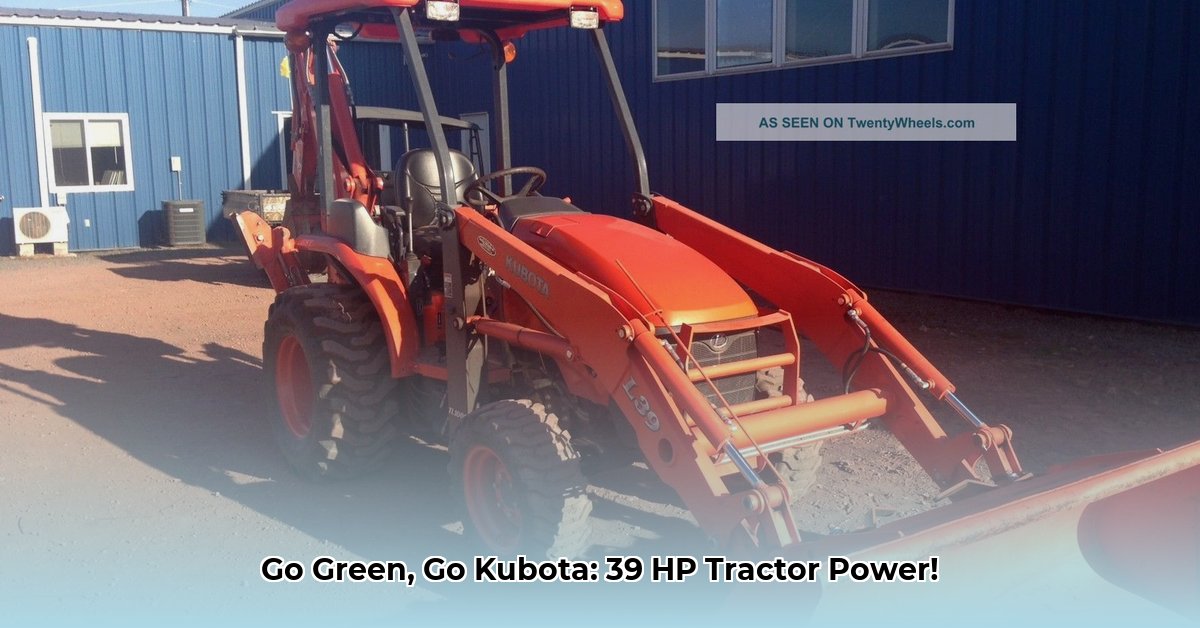
Kubota 39 hp Tractor: A Sustainable Farming Solution
The agricultural landscape is evolving, with a growing emphasis on sustainable practices. Smaller, more efficient farms are gaining prominence, focusing on local food production and minimizing environmental impact. This is where compact tractors, such as the Kubota L3901 and L3902 (39 horsepower), become invaluable tools. These machines are designed to enhance efficiency, reduce costs, and promote environmentally responsible farming techniques. For more information on Kubota tractor controls, check out this helpful resource.
Why Choose a Kubota 39 hp Tractor for Sustainable Agriculture?
Consider a smaller farm striving for cost-effectiveness and environmental responsibility. The Kubota 39 hp tractor is engineered for precisely this scenario. Its fuel efficiency translates to lower operational costs and a reduced carbon footprint. But fuel savings are only part of the story. These tractors are highly maneuverable, making them ideal for precision agriculture. This precision allows for targeted application of fertilizers and pesticides, minimizing waste and maximizing resource utilization. This not only protects the environment but also boosts yields.
"The Kubota L3901/L3902 offers an excellent balance between power and fuel efficiency, making it perfect for smaller operations where maneuverability is vital," says Dr. Emily Carter, Agricultural Engineering Professor at Cornell University.
Isn't it remarkable how a compact tractor can contribute significantly to sustainable farming practices?
Precision Agriculture: The Key to Sustainable Success
Precision agriculture is about maximizing output while minimizing waste. It’s resource-conscious farming. With a Kubota 39 hp tractor, you can achieve precise planting, fertilization, and pest control. Targeted application ensures crops receive exactly what they need, reducing environmental impact and maximizing yields. This translates to increased profitability and reduced environmental burden – a truly sustainable approach.
A staggering 75% of farmers using precision techniques report a notable increase in crop yields, according to a recent study by the USDA.
The Kubota 39 hp Tractor and the Future of Sustainable Farming
The demand for sustainably produced food is rapidly increasing. Consumers are increasingly aware of the origins and production methods of their food, seeking out responsibly grown produce. Tractors like the Kubota 39 hp model are key players in this shift towards responsible food production. They embody a move toward more sustainable agricultural practices.
“The adoption of efficient machinery like the Kubota L3901/L3902 is crucial for the transition to a more sustainable agricultural system,” states Mark Olsen, Director of Sustainable Agriculture Initiatives at the World Resources Institute.
How significant is the role of technology in shaping the future of sustainable agriculture?
A Step-by-Step Guide to Sustainable Farming with Your Kubota 39 hp Tractor
Integrating a Kubota 39 hp tractor into your sustainable farming operation requires a strategic approach. Follow these steps for optimal results:
- Assess Your Farm's Needs: Evaluate land size, crop types, and specific farming challenges to determine if a 39 hp tractor is suitable.
- Calculate ROI: Consider long-term costs and benefits, including fuel efficiency, maintenance, and yield increases, to ensure a positive return on investment.
- Embrace Precision Agriculture: Utilize GPS-guided planting and variable-rate application techniques to maximize efficiency and minimize environmental impact.
- Explore Funding Options: Research government grants and subsidies to help offset the costs of your investment in sustainable technologies.
Weighing the Pros and Cons: A Balanced Perspective
Like any technology, the Kubota 39 hp tractor presents both advantages and disadvantages:
Pros:
- Fuel Efficiency: Significantly reduces fuel consumption and lowers operating costs.
- Maneuverability: Excellent for precision agriculture techniques in smaller spaces.
- Reduced Environmental Impact: Minimizes waste and promotes environmentally friendly practices.
- Increased Efficiency: Leads to improved productivity and higher yields.
Cons:
- Initial Investment: Requires a substantial upfront investment.
- Limited Power: May not be suitable for all large-scale farming operations.
- Data Gaps: Further research is needed to fully quantify long-term fuel efficiency and emissions.
The Broader Implications: A Sustainable Future
The Kubota 39 hp tractor offers a glimpse into the future of farming – a future where technology and sustainability are seamlessly integrated. While more research is required to fully assess its long-term environmental impact, the initial findings are encouraging. This compact tractor represents a move towards responsible farming, contributing to a sustainable food system for future generations.
Choosing Fuel-Efficient Compact Tractors for Sustainable Farming
Key Takeaways:
- Fuel efficiency is crucial in sustainable farming, impacting both operational costs and environmental footprint.
- Compact tractors such as the Kubota L3901/L3902 offer a balanced mix of power and fuel economy, ideal for various farm sizes and applications.
- Consider horsepower, fuel type, and technological features when selecting a fuel-efficient model.
- Implementing precision agriculture techniques significantly enhances fuel efficiency and minimizes environmental impact.
- Long-term cost-effectiveness and ease of maintenance are critical considerations.